IRS 501 C (3) Non Profit Organization
Non Traditional Students discover they can with ICan at Kapi’olani Community College
For the entire story and pictures, click link below. A brief story is below.
http://www.hawaii.edu/news/2014/12/05/non-traditional-students-discover-they-can-with-ican/
Graduation day for 15 students who completed the Individualized Career Achievement Network or iCAN program run by Kapiʻolani Community College in partnership with the McKinley Community School for Adults.
The free, fast track career training program attracts a wide variety of students. This group of graduates is made up of 10 women and 5 men, who range in age from 18 to 74.

February 5, 2012 (Read full story)
“I am from Micronesia,” said iCAN graduate Julie Johannes. “And I am a wife, mother and grandma.”
“I recently came out of jail in February and ever since then, I just been on a straight path, just trying to change my life,” said fellow iCAN graduateNathan Paoa.
iCAN’s mission is to help participants improve their lives by finding career pathways, whether that’s college or some type of workforce training.
“We realize that students don’t have the basic skills that sometimes they need to get into those career pathways or to find the jobs that they are looking for,” said Roya Dennis, the Kapiʻolani Community College iCAN coordinator.
The 135-hour program focuses on career skills like teamwork and communication along with reading, writing, math, computer skills and a broad range of support services.
The students also tour college campuses. The iCAN program is a gateway to the world of possibility—a bridge to higher education or a fulfilling career.
“I learned that I can be myself and what I want to do for my goal, I can do it,” said Johannes. “That’s iCAN program.”
McKinley Community School for Adults and Waipahu Community School for Adults are piloting the iCAN program in a partnership between the University of Hawaiʻi Community Colleges and Department of Education Community School for Adults.
It’s part of the Community College Career Training program funded by a $24.6 million grant from the U.S. Department of Labor’s Employment and Training Administration.
At every iCAN graduation ceremony, each student gives a presentation on their career goals and how they will accomplish those goals. A big part of iCAN is to leave with a detailed plan.
“Well right now, I’m not sure what I want to do,” said Paoa. “That’s why on my presentation I had like three different things. But I know that whatever I do choose, it’s going to be worth it.”
The iCAN program is available every spring, summer and fall.
Graduates receive a National Career Readiness Certificate and a Certificate of Professional Development. They also have an option to earn a Healthcare Foundation certificate by taking an additional 30-hour course that covers the skills needed for entry-level positions in the healthcare industry.
Just like any graduation ceremony, there are a lot of laughter, tears, hugs and one last group shot.
“Now we’re done and I just go on, I want to continue on,” said Johannes right after she graduated. “So never be scared. Just go for it.”
DOH INSTALLS AIR POLLUTION MONITORS AROUND KILAUEA LAVA FLOW
DEPARTMENT OF HEALTH
DAVID Y. IGE
GOVERNOR
KEITH YAMAMOTO
ACTING DIRECTOR
FOR IMMEDIATE RELEASE
Dec. 16, 2014 14-057
HAWAII DEPARTMENT OF HEALTH INSTALLS AIR POLLUTION MONITORS AROUND KILAUEA LAVA FLOW
HONOLULU — The Hawaii State Department of Health (DOH) has installed three temporary particulate monitors to measure and inform nearby residents on the Big Island of Hawaii of the air quality levels from the lava flow from Kilauea volcano. Two monitors are currently located in Pahoa and one in Leilani Estates. These monitors may be relocated or additional monitors installed as the lava flow moves or additional breakouts occur. The monitoring data and advisories may be viewed at: http://health.hawaii.gov/cab/hawaii-ambient-air-quality-data/ orhttp://www.airnow.gov/index.cfm?action=topics.smoke_wildfires
The University of Hawaii, School of Ocean and Earth Science and Technology has also developed a model to forecast the lava flow smoke in Puna. The smoke model can be viewed at: http://weather.hawaii.edu/vmap/smoke/
“Our monitoring data and smoke model will measure and predict air quality, but this information is no substitute for good judgment. People should consider for themselves how sensitive they are to smoke exposure and act accordingly, said Gary Gill, deputy director of Environmental Health. “The smoke impact at any place or time may change due to unpredictable wind and weather conditions.”
DOH recommends that residents in smoke affected areas avoid outdoor activities or physical exertion. People with respiratory illness or heart disease, older adults and children are urged to avoid smoke exposure. Smoke may worsen symptoms for individuals who have pre-existing respiratory conditions, such as allergies, asthma, and chronic obstructive pulmonary disease (COPD). Individuals that have these conditions should keep their medication refilled and use daily (controller) medication as prescribed. Anyone who feels they may need medication or medical attention should contact their physician.
Due to the unpredictable nature of the lava flow and smoke conditions, residents and visitors are advised to listen to the Hawaii County Civil Defense updates and advisories.
# # #
MEDIA CONTACT:
Nolan Hirai
Chief, Clean Air Branch
4th Annual Kau Floating Lantern Celebration
 The 4th Annual Ka’u Floating Lantern Celebration at Punalu’u Black Sand Beach Park’s “Medicine Pond” was enjoyed by Ka’u families including mainland and foreign visitors.
Photo courtesy of H. Grace

KRHCAI attends Dept of Health Annual Domestic Violence Conference

Attendees, KRHCAI Executive Director Jessie Marques is flanked by KRHCAI Board Members Donna Kekoa, Betty Jo Adams and Heanu Grace. They recently attended the Department of Healthʻs Annual Domestic Violence Conference
US Food & Drug Admin – approves new drug to cure Hepatitis C
DEPARTMENT OF HEALTH
NEIL ABERCROMBIE
GOVERNOR
LINDA ROSEN, MD, MPH
DIRECTOR
FOR IMMEDIATE RELEASE
October 31, 2014 14-046
U.S. FOOD AND DRUG ADMINISTRATION APPROVES NEW DRUG TO CURE HEPATITIS C
HAWAII DEPARTMENT OF HEALTH HOLDS VIRAL HEPATITIS SYMPOSIUM TO INCREASE HEALTHCARE PROVIDERS’ KNOWLWEDGE OF TREATMENT OPTIONS FOR PATIENTS
HONOLULU – The U.S. Food and Drug Administration (FDA) approved a new “breakthrough” drug to treat chronic hepatitis C earlier this month that has a cure rate as high as 95 percent. Viral hepatitis B and C are the leading cause of liver cancer, and Hawaii has the highest rate of liver cancer in the United States.
The FDA designates a drug as a breakthrough therapy if preliminary clinical evidence indicates the drug demonstrates a substantial improvement over available therapies for patients with serious or life-threatening diseases.
In Hawaii, an estimated 23,000 people are affected by the hepatitis C virus, especially baby boomers. The Centers for Disease Control and Prevention (CDC) has found that nationwide more than 75 percent of adults living with hepatitis C are baby boomers born between 1945 and 1965. The CDC estimates more than 121,000 deaths could be averted nationwide by screening and successfully treating hepatitis C among baby boomers.
Hepatitis C is a viral disease that causes inflammation of the liver that can lead to diminished liver function or liver failure. Most people infected with hepatitis C have no symptoms of the disease until liver damage becomes apparent, which may take decades.
Some people with chronic hepatitis C infection develop scarring and poor liver function or cirrhosis over many years, which can lead to complications such as bleeding, jaundice (yellowish eyes or skin), fluid accumulation in the abdomen, infections and liver cancer. According to the Centers for Disease Control and Prevention, about 3.2 million Americans are infected with hepatitis C, and without proper treatment, 15 to 30 percent of these people will go on to develop cirrhosis.
Symposium: Increasing Healthcare Provider Capacity
“Hepatitis C may be the first completely curable virus, but the challenge is now making sure healthcare providers have the capabilities to treat those with hepatitis,” said Thaddeus Pham, viral hepatitis prevention coordinator with the Hawaii Department of Health (DOH)..
DOH is partnering with the Hepatitis Support Network of Hawaii, Hep Free Hawaii, and other local agencies to host “Viral Hepatitis Hawai‘i – Update 2014,” a symposium intended to provide physicians and other healthcare professionals with the latest research on the changing state of hepatitis treatment and care.
The educational conference for medical professionals, social service providers, and community members will include updates from local and national experts about hepatitis B and C diagnosis and treatment, hepatitis during pregnancy, and new drug therapies and research from the annual meeting of the American Association for the Study of Liver Diseases.
“As more effective hepatitis treatments become available and as more people receive access to affordable insurance, it is important that both the general public and the medical community in Hawaii become aware of how to treat hepatitis B and cure hepatitis C,” said Pham, who is helping to plan the upcoming symposium. “This symposium will help Hawaii’s medical community and other participants to learn about how this disease affects our ohana and what we can do about it.”
Registration for All-Day Hepatitis Symposium
The symposium will be held on Saturday, Nov. 15, 2014 at the Queen’s Conference Center from 8 a.m. to 4:30 p.m. It will include general sessions and smaller breakout sessions, exhibits, continental breakfast and lunch (brochure attached). Continuing education credits for physicians, social workers, and certified substance abuse counselors will be available.
Online registration is available at www.virahhephi.org.
For more information about hepatitis resources and events in Hawaii, go to www.hepfreehawaii.org
###
MEDIA CONTACT:
Thaddeus Pham
DOH Viral Hepatitis Prevention Coordinator
Phone: (808) 733-9298
Cellular: (808) 551-1917
Janice Okubo
DOH Communications Office
E-Cigarettes now off limits at all State Government buildings
GOVERNOR
HAWAII STATE GOVERNMENT BUILDINGS
HONOLULU – Electronic cigarettes, also known as electronic smoking devices or e-cigarettes, are now prohibited in all state government buildings under the jurisdiction of the Department of Accounting and General Services (DAGS). The new policy went into effect this month and is part of the State of Hawaii’s commitment to keep workplaces and public locations smoke-free. The policy sets the tone for private sector employers and others in the community to follow.
“Based on various tests, vapors or aerosols emitted from e-cigarettes contain nicotine and other carcinogens and toxic chemicals that are just as harmful as those in secondhand smoke of regular combustible cigarettes,” said Linda Rosen, director of the Hawaii Department of Health. “It’s important that consumers be aware that e-cigarettes are not healthier than regular cigarettes, for users or those surrounding them.”
The policy is based on the Hawaii Smoke-Free Workplace and Public Places Law, which went into effect nearly eight years ago in November 2006. The law prohibits smoking tobacco products in places open to the public and places of employment.
Under the state’s newly issued policy, e-cigarettes are prohibited from use in any enclosed or partially enclosed area such as offices, lobbies, lanai, interior courtyards, patios, covered walkways, and 20 feet from entrances, exits, windows that can be opened and ventilation intakes that serve enclosed or partially enclosed area. This mirrors the current law for regular cigarettes.
“Money isn’t the Motive” – Applied Learning student Lono Grace shares

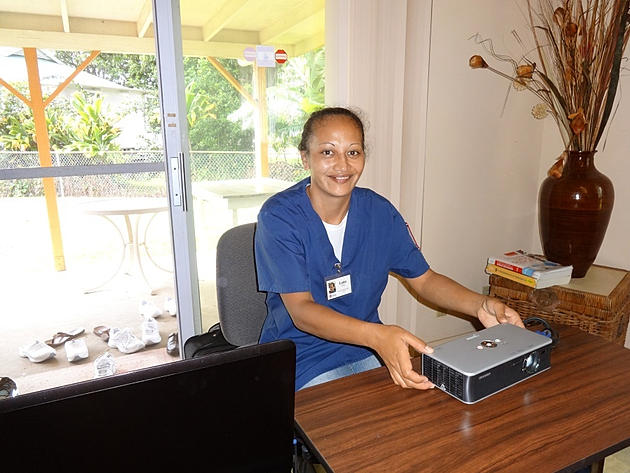
Student Lono Grace helping at the Kaʻu Licensed Practical Nursing lab. Picture provided by Luzviminda Miguel.
Money isn’t the Motive
October 8, 2014
Written by Amber Manini
In the art of nursing you learn all of the organs, body parts, and how each function working together to keep us alive. Everyone has their own reasons for wanting to work in the health field. For some of us it is for the money whereas for others it is for the eagerness to help those around us. Throughout our schooling on our way to becoming medical professionals, students have the opportunity to learn not only from their teachers but, from their peers and, through the community around them. Through these experiences students will one day become the doctors and nurses that take care of us when we can’t take care of ourselves.
Hawaii Community College Licensed Practical Nursing student, Lono Grace, is a part of the Kaʻu Cohort of student nurses. Grace, a resident of the rural Kaʻu community sees first hand the effects of the geographically isolated and medically underserved population. Lono is a student who volunteers with both the Kaʻu Rural Health Community Association as well as Hui Malama Ola Na Oiwi in Naʻalehu. She currently assists with the following; In the Kaʻu Rural Health Community Association, Board of Director, Treasurer, Co-Chair of the Fundraising Committee, Member of the Special Events Committee, and Member of the Outreach Promotional Volunteer group. Grace is a tutor for the Kaʻu Rural Health Academy and the Co-Chair for the Better Choices, Better Health Support Group.
Student Lono Grace helping at the Kaʻu Licensed Practical Nursing lab. Picture provided by Luzviminda Miguel.
“I took the initiative to promote HawCC PN program in Ka’u to members in my community to give them a positive outlook on life. When the Ka’u Sugar Plantation closed, many people lost their jobs and faced financial hardship. The only jobs readily available in the community are picking macadamia nuts, coffee or ranching. I will continue to promote the numerous programs available through Ka’u Rural Health Community Association, Inc. to the people in the community to give them the opportunity to make a difference in their lives and work smarter, not harder. I feel honored and privileged in assisting the people in the community to go back to school, further their education and create a better life,” said Grace.
Grace says she enrolled herself into the Hawaii Community College Practical Nursing Program to help the Kaʻu community as well as better herself. Upon her completion of the Hawaii Community College Practical Nursing Program she plans to continue her education here at UH Hilo achieving her Bachelors of Science in Nursing degree. As a student, Grace sees volunteering as a way to give back to her community that had once given to her. “I want the people in my community to receive the same education and quality of care that is afforded to more prominent communities. I chose to further my education and become a licensed practical nurse to benefit my community and other communities,” said Grace.
Grace is not only the type of student that has an impact on the community and her peers around her but her positive outlook also has affected her instructors as well. “She is very helpful to others. She just helps or lends a hand in any way she can, and I do not have to ask her,” said Luzviminda Miguel one of Grace’s professors. “I believe in giving back to the community and sharing the knowledge and talent that we all have. If talent and knowledge are not shared to help others or used to put a smile on someone’s face; then, they don’t mean anything and they are wasted. Giving your time to others when you can is a noble thing to do. The good actions we have can come full circle and when you need it, it will be there,” said Miguel.
The art of nursing is not one that can simply be learned from a text book. It takes dedication, time and heart. Through volunteering experiences such as the ones Grace takes part in, students are able to help the community around them while obtaining valuable first hand experience in their job field of interest. Let the eagerness and the love of helping others overpower any material object.
Tags:
science
 Kaʻū Rural Health Community Association, Inc.