News


Press Release from Hawaiʻi Public Health Institute (HIPHI)
Communities RISE Together Partnership to Support Community-Based Organizations in Local COVID-19 Vaccination Efforts in Over 25 States.

Hawaiʻi Public Health Institute to focus on Education and Equitable Access in Areas of Hawaiʻi that have been hard hit by the pandemic.
Honolulu, HI – In response to inequities in the rate of COVID-19 vaccinations in many communities of color compared to white areas, and with the surge in cases due to the more transmissible Delta variant, Hawaiʻi Public Health Institute (HIPHI) is partnering with Communities RISE Together and local partners Project Vision Hawaiʻi and Kaʻū Rural Health Community Association Inc. (KRHCAI) with a focus on COVID-19 outreach in targeted low-vaccination areas on Oʻahu and Hawaiʻi Island.
Communities RISE Together is an initiative funded by the US Department of Health and Human Services to promote vaccinations in Black, Asian-American/Pacific-Islander, Latinx, Native-American, rural, immigrant/migrant and low-income older adult populations in more than 220 counties in over 25 states and territories* with low vaccination rates. Partners WE in the World, which convenes the Well Being In the Nation (WIN) Network, and the Public Health Institute are coordinating and administering this initiative.
The COVID pandemic has revealed and worsened persistent racial, ethnic, and socioeconomic health inequities, with vastly different rates of COVID cases, vaccination rates, and health and life outcomes in communities of color, and evident in Hawaii’s current surge in cases. The Communities RISE Together initiative aims to address these gaps through trusted messengers who are already on the ground and have deep trust in communities.
Over the six month project, some of the activities supported in Hawaiʻi will include:
- Partner with community organizations to provide new and critical information regarding COVID-19 to increase awareness and confidence in the COVID-19 vaccine.
- Support the coordination of vaccination and testing sites in targeted zip codes including promotion of events and recruitment of volunteers and community leaders.
- Utilize Hawaiʻi State Department of Health data as guidance to target outreach efforts.
- Connect residents to community resources to ensure equitable access to information and resources that promote overall health and well-being for all of Hawaii’s people.
In a direct response to COVID-19, HIPHI has made intentional efforts to keep communities safe and informed with rapidly emerging science, including alerting the public when new and crucial information is released. According to Jessica Yamauchi, CEO of HIPHI, “As the impacts of the pandemic evolved over time, tapping into a vast network of connections and expertise was necessary to motivate communities and mobilize resources to hardest hit areas. Collaborating with integral community partners such as Project Vision Hawaiʻi and Kaʻū Rural Health Community Association Inc. will leverage access and resources to residents in hard-to-reach communities.”
For more information on events and volunteer opportunities happening near you or how you can volunteer, please visit these resources:
Other partners in Communities RISE Together include CHROMATIC BLACK, the Center for Popular Democracy, Latino Health Access, the Migrant Clinicians Network, Meals on Wheels America, National Councils on Aging, National Association of Area Agencies on Aging, the Public Health Institute’s Center to Advance Community Health and Equity, and WE in the World/WIN Network.
Follow #CommunitiesRISE on social media to see work as it happens across the country. Find out more about Communities RISE Together and or the U.S. Department of Health & Human Services press release on the Communities RISE award.
____________________________________________________________________________
*The states and territories are Alabama, Arkansas, Arizona, California, Federated States of Micronesia, Florida, Georgia, Hawaii, Iowa, Idaho, Indiana, Kentucky, Louisiana, Maine, Mississippi, Montana, Missouri, North Carolina, North Dakota, New Hampshire, New Mexico, Nevada, Oklahoma, Puerto Rico, South Carolina, South Dakota, Tennessee, Texas, Wisconsin and Wyoming.
# # #
NEWS RELEASE: DOH Authorizes Pfizer Booster Doses, Prioritizes First Shots & Kupuna (24-Sep-2021)
From: Vanessa Carlson <vcarlson@communityfirsthawaii.org>
To: Vanessa Carlson <vcarlson@communityfirsthawaii.org>
Sent: Friday, September 24, 2021, 01:19:18 PM HST
Subject: FW: NEWS RELEASE: DOH Authorizes Pfizer Booster Doses, Prioritizes First Shots & Kupuna
Aloha All,
Sharing with you today’s press release from the DOH in case you haven’t seen it yet.
Mahalo and have a fantastic Friday!
Vanessa
Attention all DOH employees, the following is provided for your information and sharing. You are encouraged to send out this information widely to all community partners, and others that may be interested in DOH activities. E-mail administrators please distribute. This e-mail address does not reply to inquiries.
DEPARTMENT OF HEALTH
DAVID Y. IGE
GOVERNOR
ELIZABETH A. CHAR, MD
DIRECTOR
FOR IMMEDIATE RELEASE
September 24, 2021 21-137
DOH authorizes Pfizer booster doses,
prioritizes first shots & Kupuna
First priority remains providing access to unvaccinated
individuals 65+, 50-64 with underlying conditions prioritized for booster
HONOLULU – The Hawai‘i Department of Health is issuing prioritization guidelines for the Pfizer-BioNTech COVID-19 vaccine in order to implement the U.S. Center for Disease Control and Prevention’s (CDC) recommendations on COVID-19 booster doses.
- First and second doses should have priority over any booster doses. The best way to protect Hawai‘i families and communities is to ensure that unvaccinated Hawai‘i residents complete their primary vaccine series.
- DOH recommends vaccination providers give priority to individuals age 65 and older and individuals age 50-64 with underlying medical conditions. The CDC’s strongest recommendations were to provide boosters to these groups, as waning immunity in these populations puts them at highest risk for severe illness.
- As supply allows, providers should consider booster doses for additional populations recommended by the CDC.
“As the science and the virus evolves, DOH will continue to make evidence-based decisions to ensure those at highest risk for severe illness have access to vaccines,” said Director of Health Dr. Elizabeth Char, FACEP. “We will have enough booster shots for everyone, but please allow those at highest risk for severe illness to receive their shots first. DOH’s first priority will remain encouraging unvaccinated Hawai‘i residents to complete their primary vaccine series.”
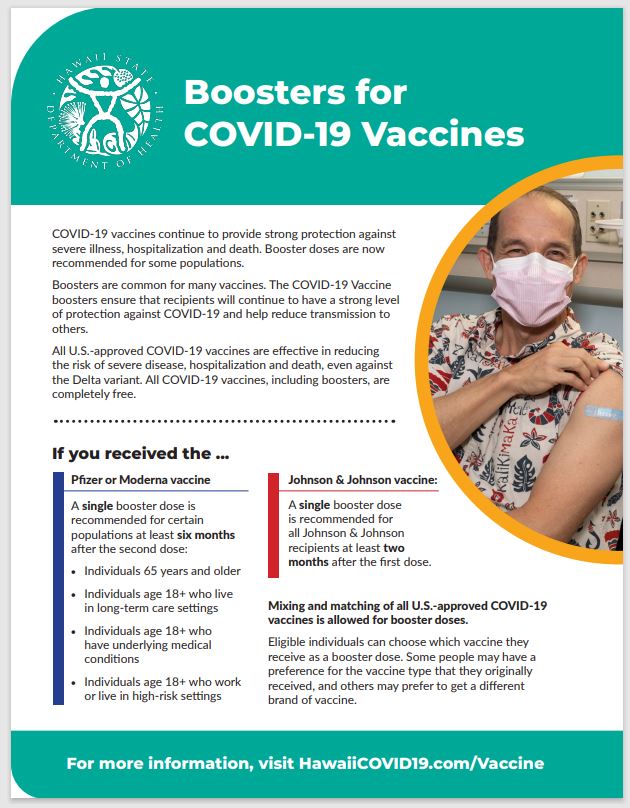
Individuals who received their second dose of the Pfizer vaccine at least six months ago and fall into the prioritization guidelines should receive a booster dose. Protection provided by the first two vaccinations continues after the six-month mark. Eligible individuals can get vaccinated any time at least six months after their second Pfizer vaccination. There is no need to rush vaccination sites.
While DOH recommends individuals 65 and older and those 50-64 with underlying conditions be given priority, other groups are also eligible to receive booster shots and should be accommodated as vaccine allocation allows. They are:
- Individuals age 18-49 with underlying medical conditions, based on individual benefits and risks.
- Individuals age 18-64 and at high risk for occupational or institutional exposure, based on individual benefits and risks.
Pfizer vaccine recipients unsure if they qualify for a booster should check with their healthcare provider.
These recommendations apply only to those who received the Pfizer vaccine. There are no changes at this time for those who received Moderna and Johnson & Johnson vaccines. Providing a Pfizer booster dose to those who received the Moderna or Johnson & Johnson vaccine is not authorized or recommended at this time.
Individuals are still considered fully vaccinated 14 days after their second dose. Booster doses provide additional protection, but the primary two-dose series continues to protect vaccinated individuals against severe illness, hospitalization and death.
# # #


Alzheimer’s Association – September 2021 Programs
September is HERE!!!That means it’s Walk to End Alzheimer’s month for Hawai‘i Island! In addition to our Walk, check out the Alzheimer’s Association’s programs going on this month as well as some COVID-19-related resources. Please reach out to me if you have any questions about our care and support programs or the upcoming Walk to End Alzheimer’s.
Mahalo,
Nic
Online Education Programs and Support Groups
Attached is our team’s schedule of Online Education Programs for this month. These programs are all via Zoom and require registration. We can also bring our programs to specific organizations or groups, so please reach out to me if this is something you may be interested in. We also continue to provide Online Support Groups for caregivers of persons living with Alzheimer’s or other dementia. If you are interested in attending our Hawai‘i Island caregiver group, please let me know.
2021 Walk to End Alzheimer’s
With the safety of our Hawai‘i Island community in mind, our Hilo Walk to End Alzheimer’s committee has decided to make this year’s Walk a “Walk wherever you are” event. We will be displaying a Walk Flower Promise Garden in town and connecting with participants through our social media platforms on September 18. There’s still time to join the fight to #ENDALZ by starting or joining a Walk team for ourHawaii Island walk. More information will be out soon, so stay tuned!
COVID-19, Alzheimer’s and Dementia
I hope everyone is staying safe and healthy as the surges in COVID-19 on Hawai‘i Island continue–especially those of us who are caregivers for loved ones with Alzheimer’s or other dementia. I wanted to remind everyone about the Alzheimer’s Association’s COVID-19, Alzheimer’s and Dementia resource website. Click here to learn more.
Also, a big mahalo to our partners at Community First Hawai‘i for letting me share a little of my family’s personal caregiving experiences in this pandemic with my 96-year-old Nana who is living with dementia. You can check it out in last Sunday’s Hawaii Tribune Herald.
Nicolas K. Los Baños
Hawai‘i Island Regional Coordinator | Alzheimer’s Association, Aloha Chapter | direct (phone/text): 808.518.6649 | nklosbanos@alz.org | alz.org/hawaii | Alzheimer’s Association 24/7 Helpline: 800.272.3900


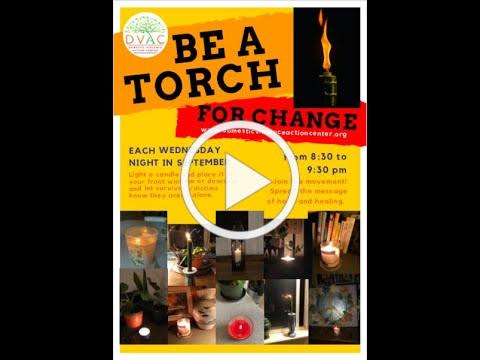
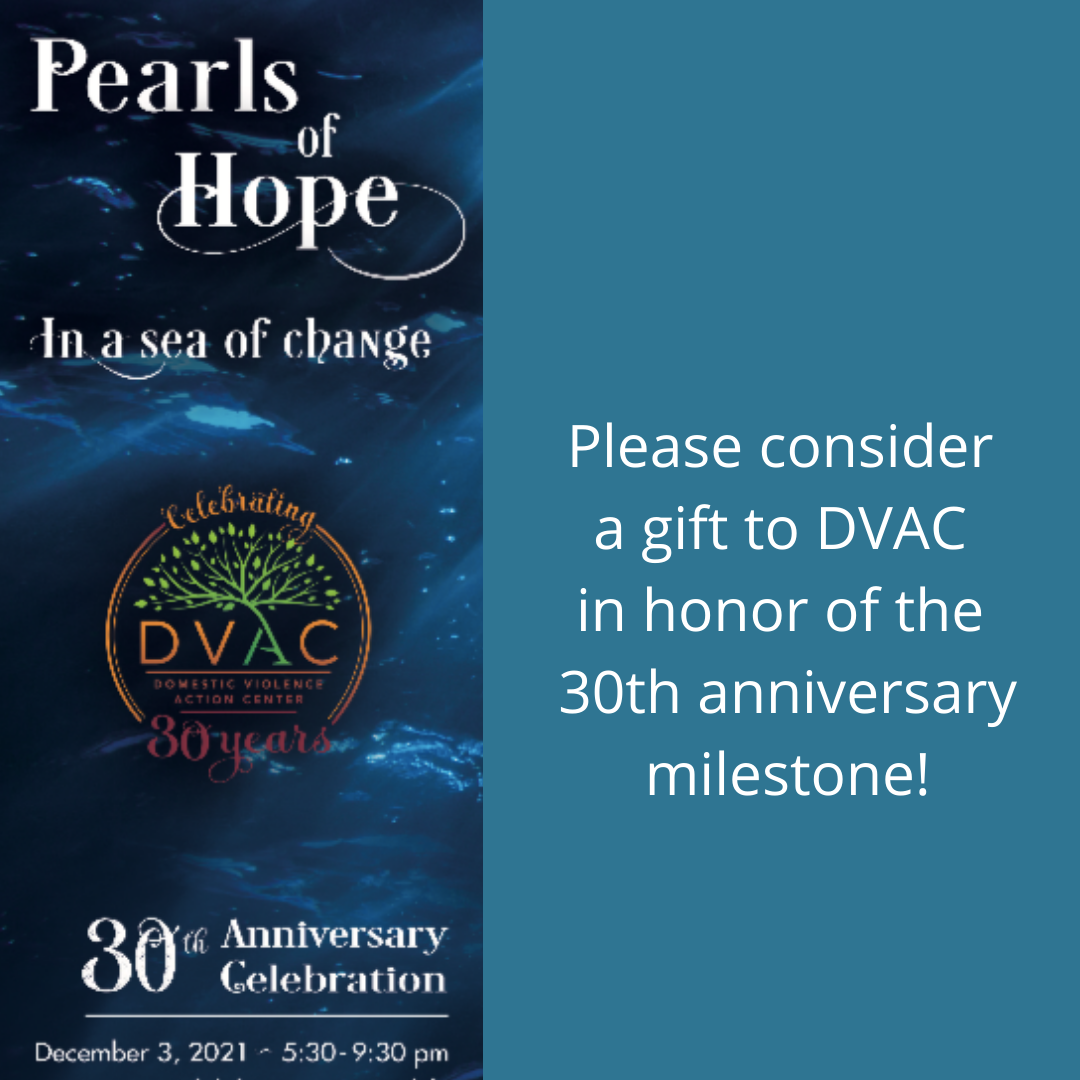
DVAC – Domestic Violence Action Center – September 2021
|
|||||||||||||||||||||||||||||||||||||||||||||||||||||||||||||||||||||||








|
Kukui Gram – September 2021
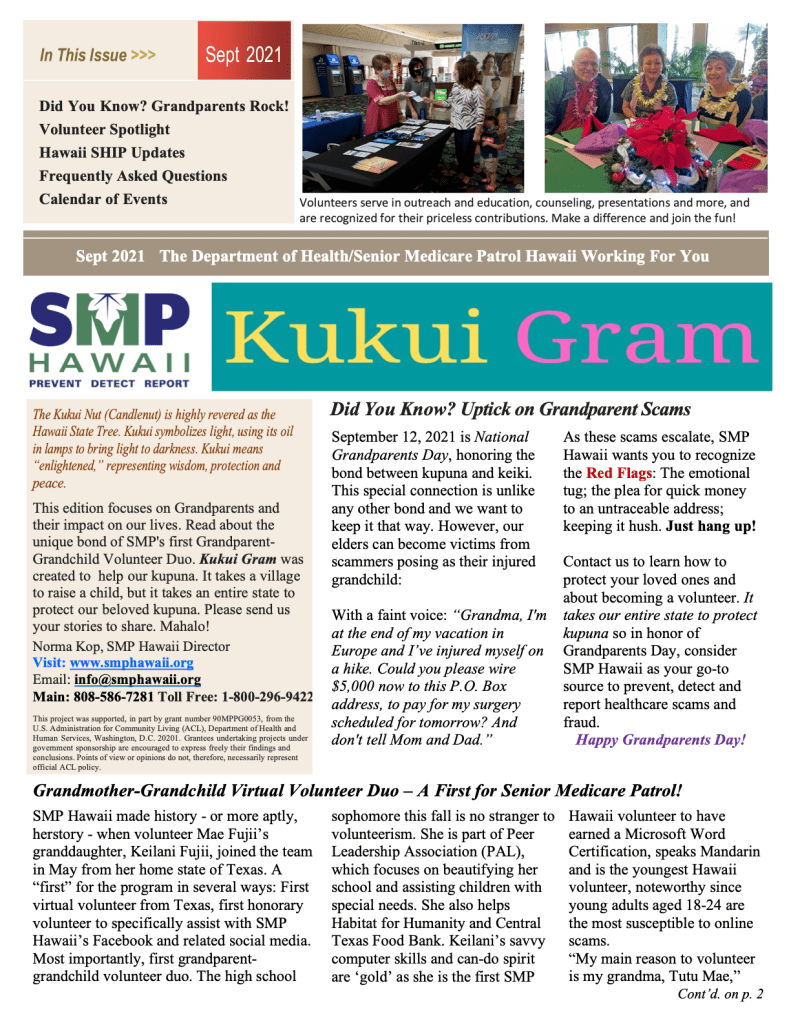
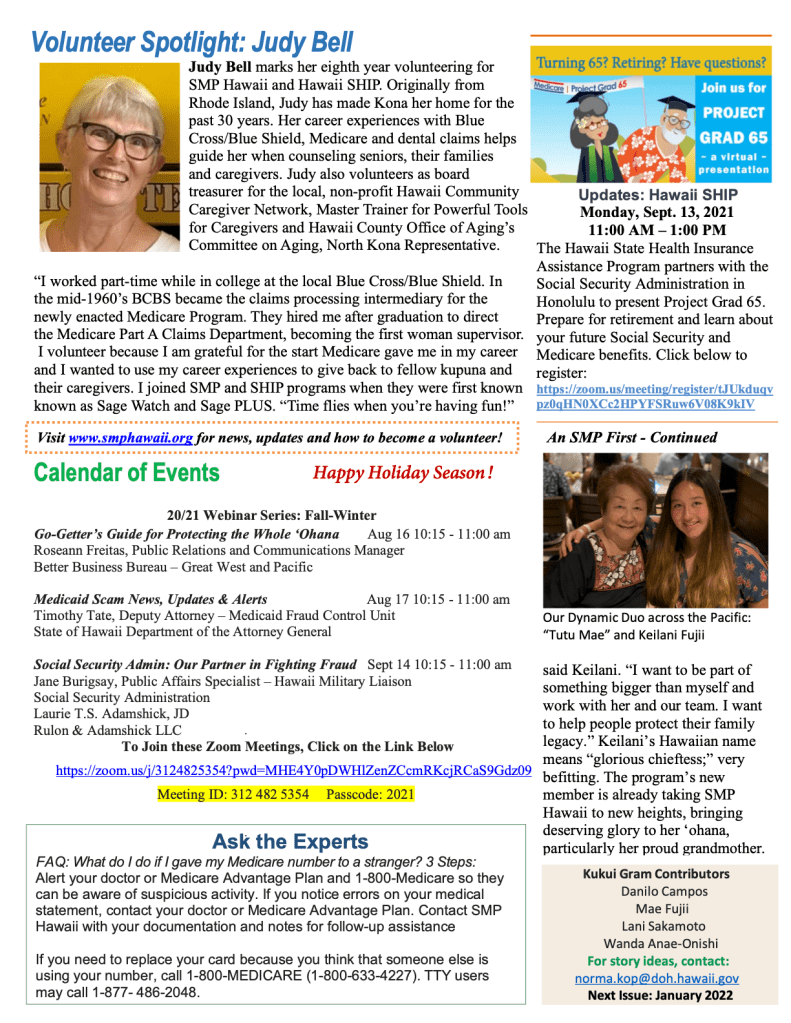
SMP Hawaii (Senior Medicare Patrol), has published the September edition of Kukui Gram. Read about Grandparent Scams and their calendar of events that are open to the public.
SMP Hawaii’s mission is to help Kupuna PREVENT, DETECT, and REPORT MEDICARE Fraud and Abuse.
Video – Covid 19 Vaccine/Testing Community Outreach
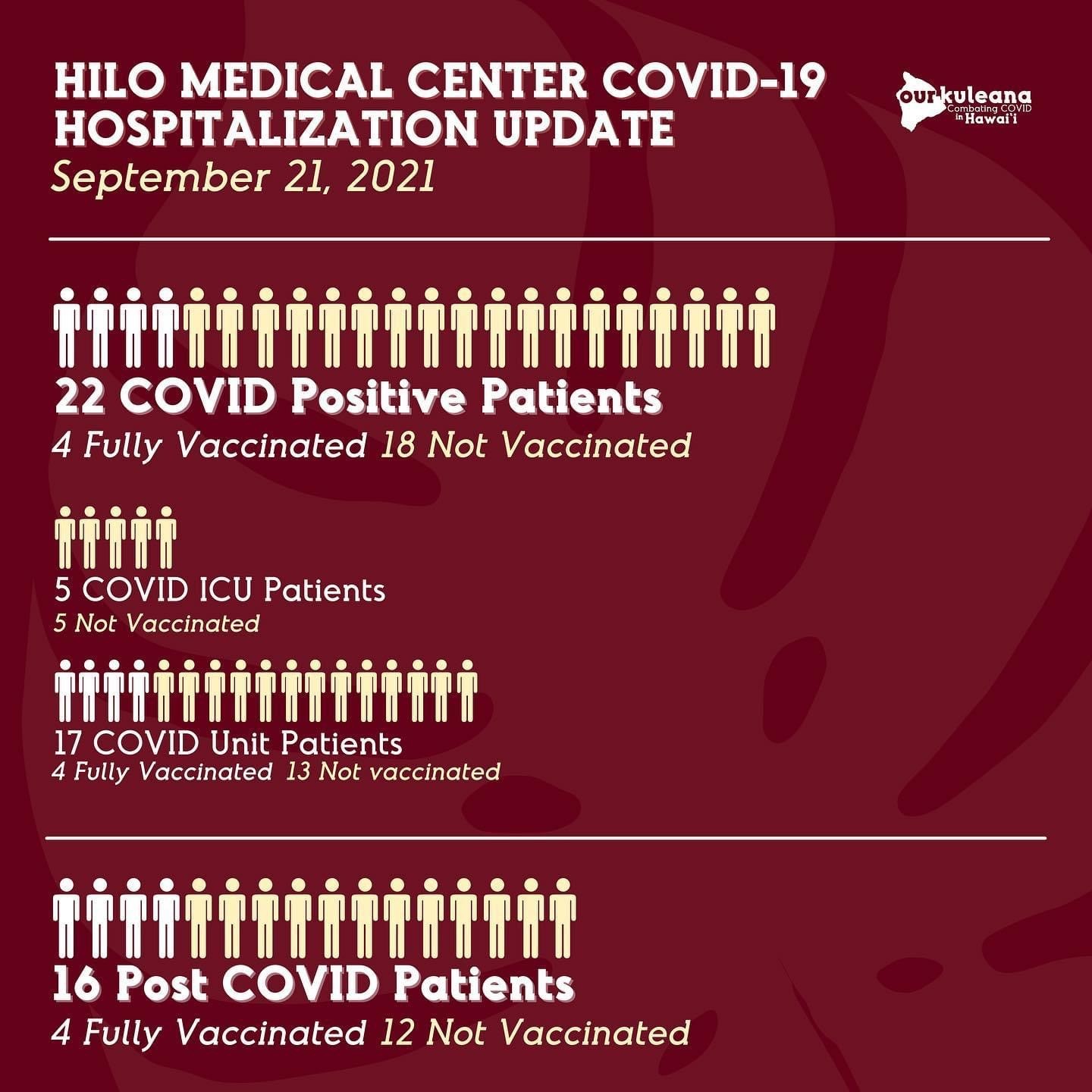
KRH Clinic on Aug 28, 2021 administered 104 Vaccines (previous count was 86), Queens’ NHCH Tested 66 people (previous count was 50).
We’ve been having great turn out for these events and we’re glad that more people are taking advantage of this opportunity.
 Kaʻū Rural Health Community Association, Inc.
